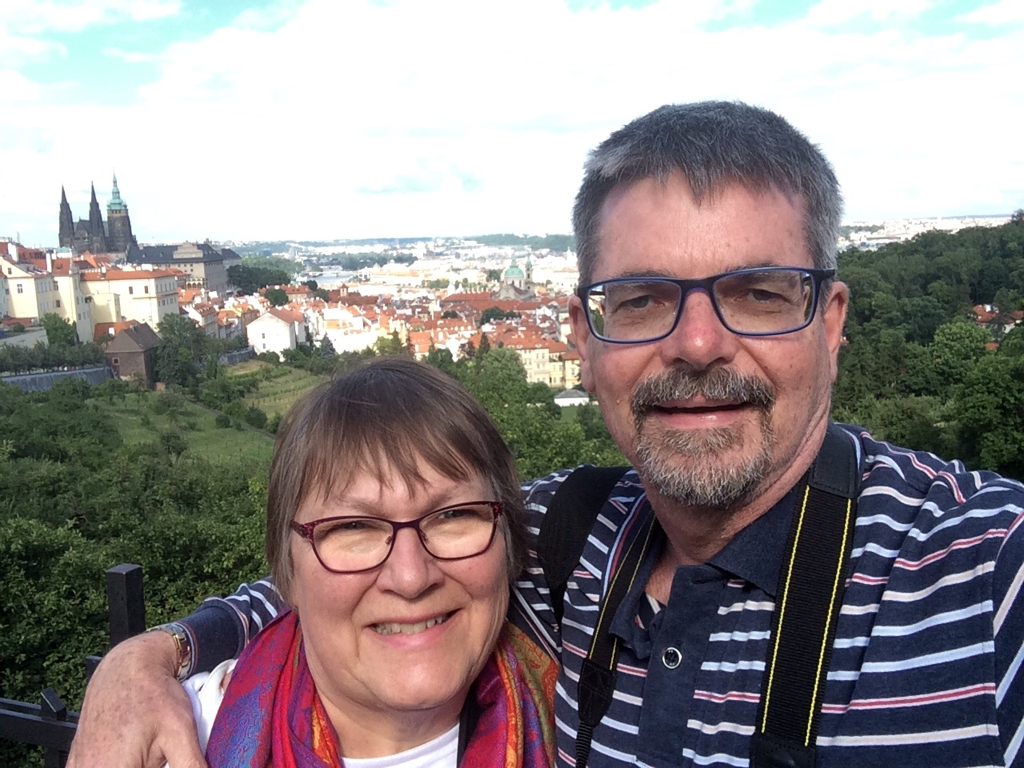
We have stayed at a rural hotel just outside Cloppenburg for three nights. It has been a quiet interlude with meandering drives through farmlamd. Two highligts have been the outdoor museum in Cloppenburg that started saving buildings in the 1930s and the cathedral in Bremen that has stunning painted features. Tomorrow we head to a little island off the coast of Netherlands where I look forward to long beach walks.
Monday, 29 June 2015
Saturday, 27 June 2015
Prague Thoughts
We left Prague this morning on a train to Hamburg which has given me time to think about what we saw over the last few days. I am sure that it will take years, literally, to process all of the art and history that is housed in that city. It has been a treat to visit!
First of all, the medieval buildings are a joy for those of us from North America who are mostly used to the flatness and newness that is architecture in the new world. I love the fairy tale feel of Prague, the sense that a jester or a knight might lurk around the next corner. I know that in reality that what is around the corner will likely be a mime or a busker but still… such scope for imagination. And speaking of buskers, the quality of street music on offer is so high. In particular two groups caught my attention: a group of young people using classical instruments to play electrified and electrifying music, and three men playing medieval music/middle eastern music on an unusual set of bagpipes, a two handled guitar and a set of drums. I managed to get a CD of the first group but didn’t get one for the second. Stan caught a few minutes of their music for me on video and I will be trying to identify it when I get home.
The river played an integral roll in our visit. A river gives a city a certain life and form. I love the bridges over it, the symbolism of it, the way it breaks the landscape and the area, gives a place for people to meet and to sense the movement of nature. In Prague there are many bridges but of course it is the Charles Bridge that is so important to the life of the city, at least to the life of tourism there. We returned to the river over and over to catch it in different lights, and with the lights on! We took a cruise along the water of course. My favourite view was the one from the restaurant beneath the Kafka Museum where the food was delicious and the view succulent. Some of my favourite photos, of the hundreds we took, were Stan’s pinholes that capture that sense of history coming up through the very cobblestones and the moistness of the air while we were there. My it can rain!
The castle hanging over the city gives such a sense of grandeur and gravitas. For much of the day, its position in the west means that it is silhouetted against the sky like a piece of finely wrought scherenshnitte. And St Vitus’s cathedral is a fine addition to that silhouette. The inside is magnificent as only a cathedral of that size can be. And the colour of the windows is beyond compare. In particular the windows at the rear of the church that were designed and built in the 20s and 30s use colour and movement in spectacular ways.
Prague pulls at your heart in the Jewish district, with sites that both uplift it and break it completely. The Spanish Synagogue has always been one of the places on my bucket list. Photos can not do it justice tho’ we certainly tried to capture every bit of the design, the colour and the decoration in our photos. I will study those images for years to come as they are a masterclass in mixing colour, texture and line in ways that are at once diverse and cohesive. This was the uplifting part. Mere blocks away was the Pinkas Synagogue. Simple white walls covered in row upon row upon row of black Neulandish lettering, broken from time to time by a red letter to mark the beginning of another family list. To see the names of the Jews lost during the Nazi years laid out so elegantly, in such volume, on the simple white walls, a soft wash of light from the leaded windows illuminating them, breaks your heart. Outside, walking through the Jewish Cemetery, somehow the heart finds rest again, strolling through the stones marking the death of lives lived as well as possible, crowded together, giving comfort to each other.
By happy accident our river cruise left from a dock across the street from the St. Agnes of Bohemia convent. Therein is housed the most amazing collection of religious art, mostly from the period around the 14th C. Hundreds of pieces from altars and churches throughout the Czech republic, with an emphasis on Mary in all her roles: mother, mourner and saint. From simple carved statues to icons and painted pieces it is another masterclass, this one in the beatification of the female face. I itch to use what I will learn from studying those faces, (they allowed photography!) in my drawing, painting and fibre work.
One of the biggest surprises of the week was the food. I will admit I came to Prague with very low expectations for the food. From the juicy burger we had the first day to the last spoonful of gelato last night we couldn’t have been more pleased with our food. In particular, the chef in our hotel (Hotel Rott in old town with an amazingly convenient location) was inventive and talented. I hate to use the word succulent twice in one day but it really is the only word that truly describes the food we were served there. The other two restaurants I would highly recommend are the one in the basement of the Kafka Museum with its amazing views of the Charles Bridge and the one in the Strahov monestary, below ground, in a cave.
Prague is a mecca for Art Nouveau enthusiasts. My fellow tanglers will be aware of Mucha, one of the foremost Art Nouveau artists, because of a tangle called Mooka. Prague was his town and there is a small museum of his posters and sketches there. I spent a pleasant hour there studying his drawings – his posters are so familiar but his detailed drawings of plants were the real treasure in the museum. Unfortunately his other works are not available for viewing as the National Museum is closed for renovations.
We walked miles and miles over our three and a half days in Prague. We had wind and rain and cold and, thankfully, a day of sun and blue skies. We saw so much and yet there is so much more to see. I’d go back and I think next time I’d use it as a jumping off place to head to Budapest and Bucharest and Croatia. But for now, my train seat faces Hamburg and I am keen to see what lies ahead as we pick up our car tomorrow and head to Stadt and Bremen and beyond. The Bremen Town Musicians await!
Wednesday, 24 June 2015
Prague Day One
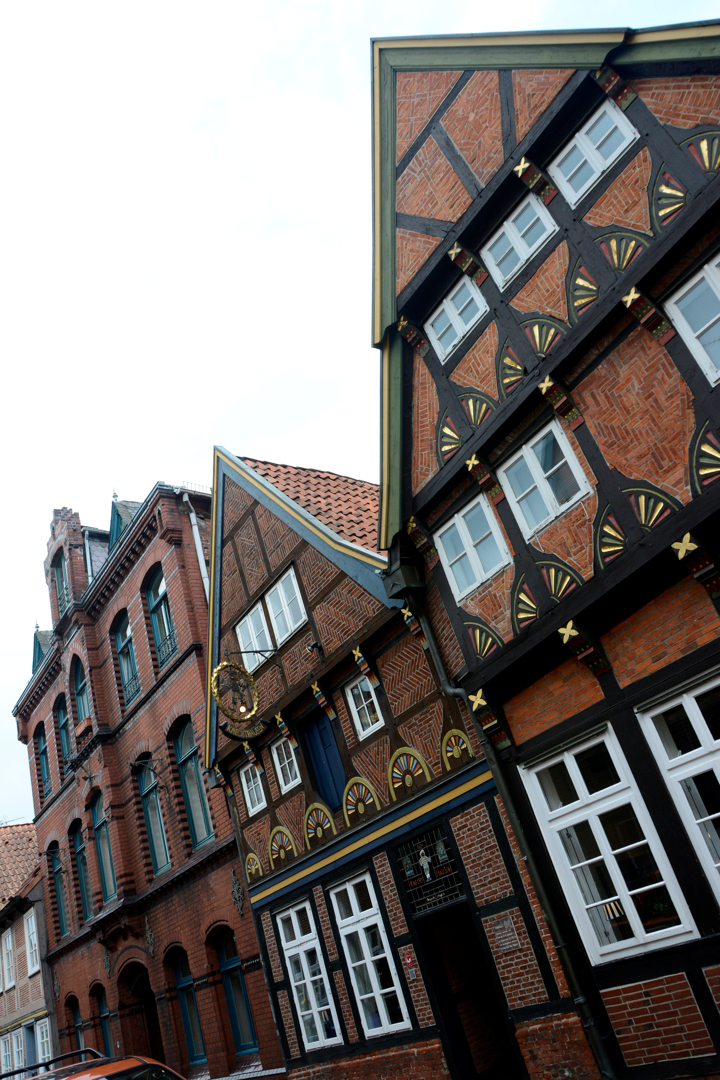
Taking a brief afternoon break before heading out to capture the late afternoon light on Charles Bridge. Sun is out for now. Only downside to Prague has been very cold, very wet weather. Of course the upside was needing a new pashmina.
Highlight of yesterday was Spanish Synagogue, a true masterclass in pattern and colour. Just a few images to make you drool. I'll be teaching with the hundreds of images we took for years to come.

And Stan is enjoying the beer!
Highlight of yesterday was Spanish Synagogue, a true masterclass in pattern and colour. Just a few images to make you drool. I'll be teaching with the hundreds of images we took for years to come.
Saturday, 20 June 2015
And we are off ... again!
![]() |
| One of Stan's pinhole photos. |
Friday, 29 August 2014
Copenhagen
We walked all over Copenhagen while we waited for check in time. Nice city to walk in. Lots of great colours used on buildings. Raining now so not sure about Tivoli tonight.
Friday, 7 March 2014
Day Eight - Genovesa
Day Eight
Our last full day at sea and our first day of rain. We awake to a light drizzle and choppier seas. It is early, just 6:15, when the wakeup call sounds and we are just pulling into Genovesa. We know that we are lucky to have an opportunity to land on this island because this is one of the few ships that currently gets permission to land here and they are only allowed to come here once every two or three weeks.
Genovesa is a caldera which means that we are inside a submerged volcano. The terrain is quite rocky and steep rising up from a few white beaches. This island is the home to an overwhelming number of seabirds and there are two opportunities to land but strictly limited numbers of people allowed ashore at any one time.
We take the first photography expedition into Darwin Bay and have already sited frigate birds with their fully inflated neck pouches before we land. The males inflate these pouches to attract females during the mating season and it is magically the right week to be here. We are surprised to see graffiti high on the walls and the guide explains that sailors have been coming here for many centuries as the caldera offers protection and a safe place to land. The oldest graffiti we see dates back to 1957 but he says there are places where you can see marks scratched into the rocks that go back to the late 1700s.
Our first steps on shore bring us face to face with the red footed boobies who not only have fanciful feet but also have turquoise and blue beaks. They hang about on scrub trees and settle into mangrove bushes all around us. Their webbed feet have claws that can grip and it is fascinating to be able to be close enough to see the mechanics of this. Their chicks are already fairly large and roost in the trees with them, their fluffy feathers fanning in the breeze. The guide also points out that although the majority of the red foots have darker feathering that there is about 5 percent of them that have an alternative colouring and, quite conveniently, he points out one of these rarer specimens in the mangroves in front of us.

The next section of pathway leads us into Nasca boobie territory (which until recently were called masked boobies) which truly are the plainest of the boobies. We don't spend much time with them as there was an opportunity to see them nesting on another island and also because we hear strange and unworldly warblings from around the corner and head off to see what is going on.
The sounds are coming from a dozen or more male frigate birds who have their red throat sack fully inflated and are shimmying their wings (remember they have about a seven foot wing span!) and trying to attract a single female who is sailing high above us. With bright red throats and iridescent green feathers around their ruff they make quite a photo. She makes many passes getting lower and lower each time. Finally she chooses one of the males and lands beside him. The warbling and shimmying continues because she still may decide that he is not the one but it seems she has chosen wisely.
There is also a pair of gold crested night herons nesting on the beach. We see both the male and female independently but their nest is high on the rocks and climbing is strictly forbidden.
We head back to the ship happy with our mornings 'catch' and Stan heads off for the last snorkeling opportunity.
A little bit more to come... we head homeward tomorrow.
Our last full day at sea and our first day of rain. We awake to a light drizzle and choppier seas. It is early, just 6:15, when the wakeup call sounds and we are just pulling into Genovesa. We know that we are lucky to have an opportunity to land on this island because this is one of the few ships that currently gets permission to land here and they are only allowed to come here once every two or three weeks.
Genovesa is a caldera which means that we are inside a submerged volcano. The terrain is quite rocky and steep rising up from a few white beaches. This island is the home to an overwhelming number of seabirds and there are two opportunities to land but strictly limited numbers of people allowed ashore at any one time.
We take the first photography expedition into Darwin Bay and have already sited frigate birds with their fully inflated neck pouches before we land. The males inflate these pouches to attract females during the mating season and it is magically the right week to be here. We are surprised to see graffiti high on the walls and the guide explains that sailors have been coming here for many centuries as the caldera offers protection and a safe place to land. The oldest graffiti we see dates back to 1957 but he says there are places where you can see marks scratched into the rocks that go back to the late 1700s.
Our first steps on shore bring us face to face with the red footed boobies who not only have fanciful feet but also have turquoise and blue beaks. They hang about on scrub trees and settle into mangrove bushes all around us. Their webbed feet have claws that can grip and it is fascinating to be able to be close enough to see the mechanics of this. Their chicks are already fairly large and roost in the trees with them, their fluffy feathers fanning in the breeze. The guide also points out that although the majority of the red foots have darker feathering that there is about 5 percent of them that have an alternative colouring and, quite conveniently, he points out one of these rarer specimens in the mangroves in front of us.
The next section of pathway leads us into Nasca boobie territory (which until recently were called masked boobies) which truly are the plainest of the boobies. We don't spend much time with them as there was an opportunity to see them nesting on another island and also because we hear strange and unworldly warblings from around the corner and head off to see what is going on.
The sounds are coming from a dozen or more male frigate birds who have their red throat sack fully inflated and are shimmying their wings (remember they have about a seven foot wing span!) and trying to attract a single female who is sailing high above us. With bright red throats and iridescent green feathers around their ruff they make quite a photo. She makes many passes getting lower and lower each time. Finally she chooses one of the males and lands beside him. The warbling and shimmying continues because she still may decide that he is not the one but it seems she has chosen wisely.
There is also a pair of gold crested night herons nesting on the beach. We see both the male and female independently but their nest is high on the rocks and climbing is strictly forbidden.
A little bit more to come... we head homeward tomorrow.
Subscribe to:
Posts (Atom)